Rinogik: A Bold Display Font for Handmade Labels & Branding
As someone who hand-presses candle labels, cuts vinyl for boutique tags, and designs printable wedding suites for Etsy, I know how much a single font can shift the entire feel—and function—of a product. Rinogik isn’t just another display font. It’s got presence: confident letterforms, balanced weight, and that rare mix of boldness and clarity that reads beautifully at 12pt on a tea towel tag or 120pt on a farmhouse welcome sign.
Rinogik is a premium display font built for impact—not decoration. Its clean, slightly geometric structure gives it strong legibility even when cut small on Cricut or Silhouette machines. No awkward gaps, no fragile serifs that vanish at 8mm height, no excessive flourishes that gum up your vinyl weeding. Just solid, intentional shape—ideal for physical products where every millimeter counts.
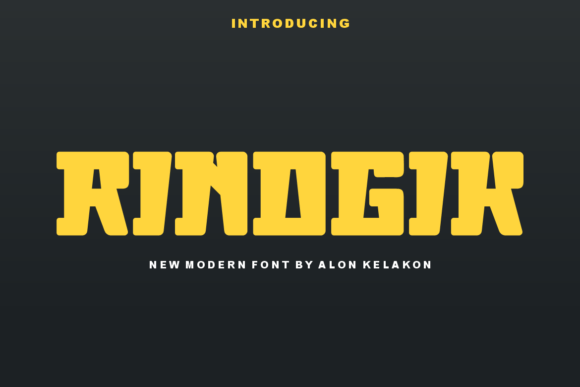
I’ve used Rinogik on soy wax candle jars (heat-resistant label vinyl), cotton tote bags (screen-printed with minimal ink bleed), and foil-stamped greeting cards—and each time, it held its own without looking stiff or overdesigned. The uppercase letters carry subtle personality: a slight taper on the “R”, a confident crossbar on the “E”, a grounded “G” that anchors any word it ends. Lowercase is intentionally limited in this style—it’s meant for titles, names, and short phrases, not body text. That’s not a limitation; it’s focus.
For handmade sellers, that focus is gold. Think about your best-selling item: maybe it’s lavender-scented bath salts in amber glass jars. A label with “Lavender Dream” set in Rinogik feels elevated—not fussy, not trendy, but quietly assured. Customers don’t just read the name—they register quality, intention, care. That perception starts with typography. Rinogik supports that narrative without shouting.
It shines brightest where space is tight and attention is scarce: product tags on clothing racks, die-cut stickers for planner inserts, holiday ornament packaging, or chalkboard-style menu boards for local cafes. I recently designed a set of printable Halloween party printables—invitation, treat bag toppers, and photo booth props—and used Rinogik for all headlines. The contrast between its bold rhythm and a soft handwritten script for body text created instant visual hierarchy—and buyers told me the files “felt cohesive, like a real brand.”
Readability matters most when scaling down. Rinogik holds up well at 6–8mm tall on iron-on patches or woven labels, especially if you avoid ultra-thin strokes or overly tight kerning. For Cricut users: test cut at 10mm first using the “Weld” function to ensure connected letters (like “fi” or “fl”) stay intact. Rinogik includes standard OpenType features—ligatures and alternate characters—but they’re tasteful, not overwhelming. You’ll find them useful for customizing “The Cozy Corner” or “Wild & Rooted” without needing design software acrobatics.
Pairing Rinogik thoughtfully multiplies its usefulness. With a warm, relaxed script font—think flowing connectors and gentle baseline variation—you get instant charm for wedding stationery or artisanal soap branding. Pair it with a clean, neutral sans serif (like Montserrat or Inter) for modern packaging or digital templates, and you create balance: personality + professionalism. Avoid pairing it with other heavy display fonts—that’s visual noise, not harmony. And while Rinogik isn’t a serif font or a handwritten font, it plays beautifully *alongside* both.
File formats matter when you’re building SVG bundles or layered PNG kits for crafters. Rinogik comes in OTF and TTF—both fully compatible with Cricut Design Space, Silhouette Studio, Canva, and Adobe Suite. No missing glyphs, no encoding hiccups. If you’re creating multilingual printables (e.g., bilingual baby shower invites), check whether the version you purchase includes extended Latin support—it’s essential for accented characters in Spanish, French, or German markets.
One practical note many makers overlook: commercial licensing. Rinogik is a commercial font, meaning you’re fully cleared to use it in physical products you sell—candle labels, t-shirt prints, sticker sheets—as well as digital downloads like Canva templates, SVG cut files, and printable planners. Just verify your license covers *both* physical and digital resale (some basic licenses restrict one or the other). When in doubt, email the foundry—they respond quickly, and it’s worth confirming before listing 500 units on Etsy.
Real-world examples that work right now: a “Freshly Baked” header on bakery packaging, “Est. 2023” stamped on leather journal tags, “You’re Invited” centered on a kraft invitation suite, “Holiday Magic” arched over a printable advent calendar, or “Small Batch • Big Flavor” on hot sauce bottles. Each uses Rinogik’s strength—its ability to say something meaningful in few words, with zero ambiguity and full warmth.
What makes Rinogik different from other bold display fonts? It doesn’t lean into retro, grunge, or futuristic tropes. It’s contemporary without being cold, expressive without being exhausting. It’s the kind of typeface that grows with your shop—from your first Etsy listing to your wholesale line—because it adapts without fading into background noise.
If you’re refreshing your font library for 2024, consider what you reach for most: the go-to for logo mockups, the reliable choice for client presentations, the one that makes your seasonal product photos pop without extra editing. Rinogik earns that spot—not because it’s flashy, but because it’s functional, friendly, and finished with craft-level attention.
Add Rinogik to your collection not just for its look, but for its reliability across materials, machines, and markets. Then start creating—labels, tags, signs, printables, packaging—with confidence that your typography is working as hard as you are.